
Vi-CELL MetaFLEX Bioanalyte Analyzer
Automated Metabolite Analysis for Bioprocess Monitoring
Measuring samples as small as 65 µL and returning results in just 35 seconds, our Vi-CELL MetaFLEX bioanalyte analyzer evaluates pH, pO2, pCO2, glucose, lactate, electrolytes and more. With less maintenance, more reliability and a surprisingly small footprint, it’s a sophisticated research solution that profiles test samples quickly, easily and accurately—keeping your test cell cultures in balance, viable and growing.
The MetaFLEX Analyzer is available in selected geographies. The MetaFLEX analyzer is part of the Vi-CELL platform of products. Please check with your Beckman Coulter representative for availability.
Download Product Brochure


Explore Vi-CELL MetaFLEX Bioanalyte Analyzer Models and Parts
Vi-CELL MetaFLEX Bioanalyte Analyzer Features
Operation
- Results in 35 seconds*
- Small sample volume (65 μL, all parameters)*
- Process 44 samples per hour*
- Cycle time per sample is 1 minute*
- 23.5 hours per day average uptime**
*May vary during startup
**May vary during startup (2.5 min for system calibration is longest activity)
Quality Management
- 3 dedicated QC solutions
- Automatic failure detection & resolution
- Continuous system & analysis checks
- Automatic lockout of parameter(s) that fail QC
- Customizable QC schedule
21 CFR Part 11 Enabled
- Sample results log: 2000
- Activity log: 5000
- Calibration adjustment log: 1000
- Data secured by password protection
- Electronic signature capability
- Secure user sign-on (8 user level permissions)
- Administrative configuration tools
Applications
- R&D
- QC
- Manufacturing
Ideal for micro to large scale cell culture applications, the Vi-CELL MetaFLEX is designed for rapid and accurate bioanalyte analysis.
Reagents and Accessories

VI-CELL MetaFLEX Sensor Cassette 300/30
Vi-CELL MetaFLEX sensor cassette, SC300 measures pH, pO2, pCO2, Glucose, Lactate, Electrolytes and more parameters associated with whole blood analysis
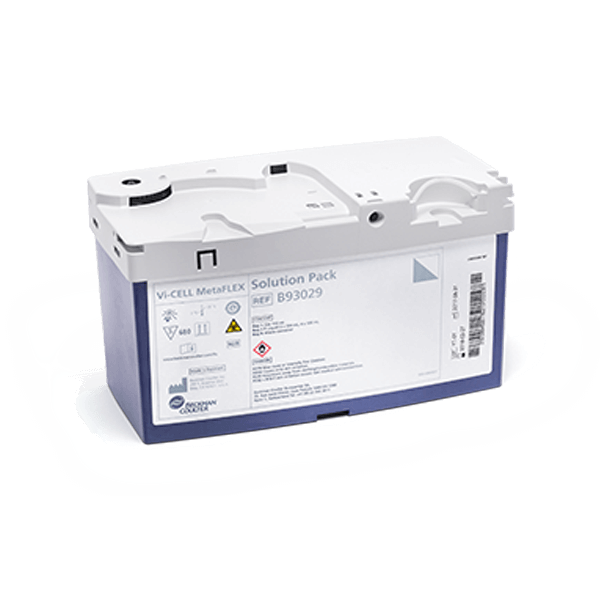
VI-CELL MetaFLEX Solution Pack
The solution pack for the Vi-CELL MetaFLEX enables ease-of-use with on-screen instructions and simple step-by-step guidance. All necessary fluids are contained within this replaceable solution pack. The solution pack also contains the solutions required to perform internal quality control and calibrations, as well as a container for waste.
Technical Documents
FAQ on Vi-CELL MetaFLEX
What is the importance of metabolites?
Metabolites reflect the physiological state of cultures in real time (or near real time) and their analysis provides important data on:
- Cell health and viability: Detecting stress and maintaining favorable growth conditions.
- Metabolic balance: Understanding fluxes to minimize byproduct accumulation.
- Process consistency: Reducing batch-to-batch variability through informed control.
- Productivity and quality: Aligning upstream conditions with downstream requirements and critical quality attributes (CQAs).
Across cell culture-based bioprocesses, including microbial and mammalian systems, tight control of key bioanalytes and metabolites is fundamental to maintaining cell health, preserving metabolic balance, ensuring reproducible batch performance, and maximizing yield. Cell growth and productivity are governed by the dynamic consumption of nutrients such as carbon sources, amino acids, vitamins, and trace elements, along with the accumulation of metabolic byproducts including lactate and ammonium, all of which can significantly influence process performance and product quality. Comprehensive metabolite monitoring provides critical insight into intracellular and extracellular environments, enabling informed control strategies during upstream cultivation and media optimization. Beyond cultivation, downstream processing frequently represents a major bottleneck, requiring efficient recovery of target products from complex reaction matrices; here again, detailed bioanalytical monitoring is essential to optimize recovery efficiency, preserve biological activity, and meet stringent regulatory and sustainability requirements. Collectively, analytics across upstream and downstream stages constitute a cornerstone of bioprocess understanding, optimization, quality assurance and consistent manufacturing outcomes [Scheper et al., 1999; Vijayasankaran, 2014].
Why is continuous monitoring of cell metabolism and environmental conditions essential in bioprocessing?
At the core of biotechnological manufacturing lies the cultivation of living cells or microorganisms under tightly controlled and reproducible conditions to safeguard cell health, metabolic balance and long-term productivity. Within a bioprocess, the biological system formed by these cells operates in continuous interaction with its physical and chemical environment, and its metabolic state, activity and productivity are highly sensitive to even subtle environmental perturbations. Nutrients consumed by the cells and metabolites produced during cultivation serve as essential indicators of cellular physiology, providing direct insight into:
- Cell viability
- Stress responses
- Metabolic flux
- Product formation
What are regulatory expectations for adopting Process Analytical Technology (PAT) and Quality by Design (QbD)?
Regulatory agencies are increasingly setting expectations for real-time monitoring and enhanced process control through the adoption of Process Analytical Technology (PAT) and Quality by Design (QbD) frameworks. Introduced by the U.S. FDA, PAT promotes real time (or near real time) measurement of critical process parameters and bioanalytes to enable proactive control strategies, moving away from reliance on end product testing. This regulatory shift reflects a broader transition toward manufacturing approaches that emphasize process understanding, transparency and lifecycle management. As biologic drugs continue to expand in complexity and clinical importance, regulators now expect manufacturers to demonstrate robust control strategies supported by timely, high-quality process data to ensure consistent product safety, efficacy and quality throughout commercial production [FDA, 2004; Rathore & Winkle, 2009].
Why are precise monitoring and control strategies critical for ensuring consistent quality in biotherapeutic production?
The complex interplay between cells, environment, and metabolite dynamics ultimately determines batch consistency, yield and product quality, making comprehensive monitoring and control indispensable for steering biochemical reaction networks toward desired outcomes [Scheper et al., 1999]. These considerations are especially critical in the production of biotherapeutics that are used for treating a wide range of medical conditions, including:
- Cancers
- Cardiovascular diseases
- Organ transplant rejection
- Respiratory diseases
- Autoimmune diseases
- Neurological diseases
The steadily increasing number of approved biotherapeutic products reflects both their clinical importance and the pharmaceutical industry’s progress in developing robust, scalable bioproduction processes, particularly for complex modalities such as monoclonal antibodies [Coulet et al., 2022].
How do rapid, multiparameter bioanalyzers improve process robustness and support PAT and QbD alignment?
A rapid and accurate bioanalyte analyzer designed for applications across R&D, quality control and manufacturing must prioritize fast, precise measurement of critical culture variables using minimal sample volumes. By providing multiparameter readouts from small samples, such systems deliver actionable insights closer to the time of sampling, enabling earlier detection of metabolic shifts and more consistent control of the cell culture environment. This tight integration of rapid measurement with existing workflows: [Michelle et al. 2023]
- Supports timely decision-making
- Enhances process robustness
- Improves alignment with PAT and QbD principles
- Contributes to more reliable and efficient bioprocess development and manufacturing
An example of this class of solutions is the Vi-CELL MetaFLEX Analyzer, which illustrates how advances in sensor miniaturization, automation and integrated quality management can be applied to routine bioanalyte monitoring in mammalian and insect cell culture processes [Michelle et al.]. The system includes automated quality checks and continuous performance monitoring, with features such as air detection and configurable QC routines to help ensure reliable measurements and maintain data integrity during routine operation.
