
The Coulter Principle (1954-1955)
While under contract to the United States Navy in the late 1940s, Wallace H. Coulter developed a technology for counting and sizing particles using impedance measurements. The technology was principally developed to count blood cells quickly by measuring the changes in electrical conductance as cells suspended in a conductive fluid passed through a small orifice. Presently, over 98% of automated cell counters incorporate this technology, which is referred to as the Coulter Principle. In the past seventy-five years, the technology has also been used to characterize thousands of different industrial particulate materials.
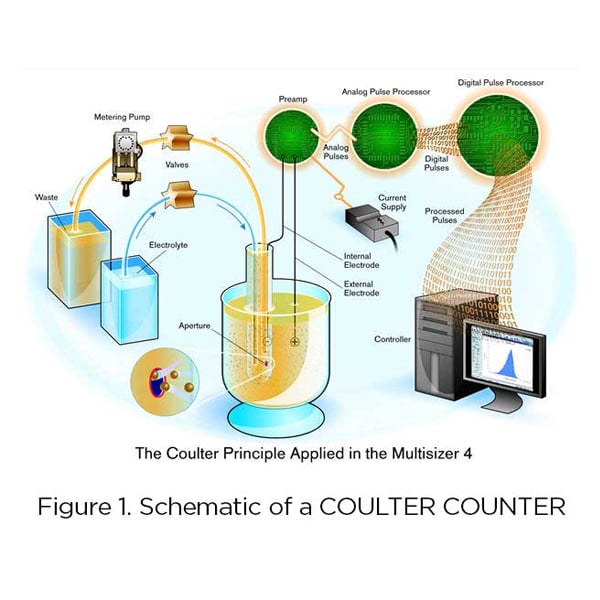
Beckman Coulter instrument systems which utilize this principle are called COULTER COUNTER instruments. Drugs, pigments, fillers, toners, foods, abrasives, explosives, clay, minerals, construction materials, coating materials, metals, filter materials, and many other sample types have all been analyzed using the Coulter Principle. This method can be used to measure any particulate material that can be suspended in an electrolyte solution. Particles as small as 0.4 µm and as large as 1600 µm in diameter can routinely be measured. Over 8,000 references to the uses of this technology have been documented.
In a COULTER COUNTER instrument, a tube with a small aperture on the wall is immersed into a beaker that contains particles suspended in a low-concentration electrolyte. Two electrodes, one inside the aperture tube and one outside the tube but inside the beaker, are placed and a current path is provided by the electrolyte when an electric field is applied (Figure 1). The impedance between the electrodes is then measured. The aperture creates what is called a "sensing zone". Particles in low concentration, suspended in the electrolyte, can be counted by passing them through the aperture. As a particle passes through the aperture, a volume of electrolyte equivalent to the immersed volume of the particle is displaced from the sensing zone. This causes a short-term change in the impedance across the aperture. This change can be measured as a voltage pulse or a current pulse. The pulse height is proportional to the volume of the sensed particle. If constant particle density is assumed, the pulse height is also proportional to the particle mass. This technology is also referred to as aperture technology.
Using count- and pulse-height analyzer circuits, the number and volume of each particle passing through the aperture can be measured. If the volume of liquid passing through the aperture can be precisely controlled and measured, the sample concentration can also be determined. In modern COULTER COUNTER instruments, such as the Multisizer™ 3 and 4, particle counter and sizing instruments, pulses are digitized and saved with several key parameters that describe each pulse such as pulse height, pulse width, time stamp, pulse area, etc. These parameters enable the instrument to better discriminate between noise and real pulses as well as between normal and distorted pulses due to various reasons when particles pass through the aperture. Saved pulses can be used to monitor sample changes over the measurement time period should pulses be arranged in time sequence. In practice, particle volume is often represented in terms of equivalent spherical diameter. The measured particle volume (or size) can be then used to obtain particle size distribution.
With counting and sizing rates of up to 10,000 particles per second, it takes less than one minute to perform a typical measurement with a COULTER COUNTER instrument. The accuracy of size measurements can be better than 1%. Aperture size typically ranges from 20-2000 µm. Each aperture can be used to measure particles within a size range of 2 to 80% of nominal diameter. Therefore, an overall particle size-range of 0.4-1600 µm is feasible. However, the ability of the technology to analyze particles is limited to those particles that can be suitably suspended in an electrolyte solution. The upper limit therefore may be 500 µm for sand but only 75 µm for tungsten carbide particles. Moreover, the lower size limit is restricted by electronic noise generated mainly within the aperture itself. The selection of the most suitable aperture size is dependent upon the particles to be measured. If the sample to be measured is composed of particles largely within a 30:1 diameter size range, the most suitable aperture can be chosen. For example, a 30 µm aperture can measure particles from about 0.6 to 18 µm in diameter. A 140 µm aperture can measure particles from about 2.8 to 84 µm. If the particles to be measured cover a wider range than a single aperture can measure, two or more apertures must be used and the test results can be overlapped to provide a complete particle size distribution.
Highest Resolution for Particle Size Analysis
 During the Coulter Principle measurement, as a particle passes through the sensing zone when the liquid is drawn from the container, a volume of the electrolyte equivalent to the immersed volume of the particle is displaced from the sensing zone. This causes a short-term change in the resistance across the aperture. This resistance change can be measured either as a voltage or current pulse. By measuring the number of pulses and their amplitudes, one can obtain information about the number of particles and the volume of each individual particle.
The number of pulses detected during measurement is the number of particles measured, and the amplitude of the pulse is proportional to the volume of the particle. Because this is a single-particle measurement process, it yields the highest resolution that any particle characterization technique can achieve. The particle diameter can be determined at the resolution of voltage or current measurement which can be very accurately using current electronics technology. The distribution amplitude can be determined to the accuracy of a single particle.
The advantages of such high resolution are multiple with the most obvious being the capability to display details of a particle size distribution. In a particle size distribution measurement, typically each distribution, whether displayed cumulatively or differentially, is composed of a few-hundred data points in a pre-set size range. Each data point is called a bin. Since every particle is measured, each bin is a collection of particles in a given size range. Depending on the distribution broadness, the total size range can be reset to a finer division, therefore showing the distribution details (i.e., each bin can be pre-set to cover a smaller size range).
Other advantages include fine differential between two particles and more accurate statistic values calculated from the distribution. The figures below show a sample measured using the Beckman Coulter Multisizer 4 and displayed in different size ranges. The pulse data was resorted into a finer set of bins in the right figure in which more detail of the distribution is displayed.
Digital Pulse Process
In Coulter Principle instrumentation, the change in electric resistance due to passages of particles through the aperture is determined using fast electronic circuitry. Detected signals are instantaneously digitized at a rate of a few-million times per second into digital signals. The digital signal is then recorded for every pulse in the form of pulse parameters (i.e., timing, height, width of pulses, etc.). As most measurements seek to obtain particle counting or size distribution, the recorded pulse height is converted to particle size using the calibration constant and placed into one of the pre-set size bins. Particle size distribution and counting are the cumulative result of all pulses measured. All recorded pulse parameters are still available for purposes other than standard, full-range particle size distribution. These parameters can be subtracted or sorted (i.e., reprocessed differently based on specific applications). For example, if an operator seeks to have a zoom-in size distribution showing every detail of the distribution, then a narrower size range can be selected and all pulses can be sorted and placed into the new set of finer bins. Another example is found when pulse heights (or sizes) are sorted in a time sequence (for samples of narrow size-distribution) t monitor sample change during measurement. Still another example is using one plot pulse height as a function of pulse width to find information of particle shape.
As a particle passes through the aperture, it creates a resistance. The bigger the particle, the more the resistance, the greater the voltage. Each voltage spike is directly proportional to the size of the cell. Today every modern hematology analyzer depends in some way on the Coulter Principle.


Coulter Counter Model F

A method was devised for using the model F Coulter Counter for counting goat erythrocytes, which are smaller and more numerous than those of humans. Blood samples were taken from 25 goats, and the cells were counted using 100- and 70-micron aperature tubes. A visual count also was made of a portion of each sample. The results were analyzed statistically to determine which aperture would produce the most accurate and reproducible results when compared with the manual counts. It was found that counts obtained with the 100-micron aperature tube were not significantly different from the manual counts.
This technology found commercial success in the medical industry where it revolutionized the science of hematology. Red blood cells, white blood cells and platelets make up the majority of the formed elements in the blood. When whole anticoagulated human blood is diluted with isotonic saline, the Coulter principle can be applied to count and size the various cells that make up whole blood. The first commercial application of the Coulter principle to hematology came in 1954 with the release of the Coulter Counter Model A (developed by Wallace and brother Joseph R. Coulter.
Within a decade, literally every hospital laboratory in the United States had Coulter Counter, and today every modern hematology analyzer depends in some way on the Coulter Principle.
Explore Different Instruments within Our Portfolio
We offer a wide variety of instruments for total optimization of your laboratory. Our focus on innovation, reliability and efficiency has led us to become the partner of choice for clinical, research and industrial customers around the globe.
Centrifuges
Our centrifuge portfolio ranges from the Microfuge line and larger, high-performance benchtop models to floor-model ultracentrifuges, and analytical ultracentrifugation (AUC) instruments.Flow Cytometers
We offer research and clinical models that take the best of legacy flow cytometers and set a new standard for more compact, more versatile and more powerful instruments.Liquid Handlers
A variety of configurations allows you to optimize performance and reduce hands-on time for most genomic, drug discovery and basic research application workflows.Cell Analyzers
The COULTER COUNTER Analyzers provide size distribution in number, volume and surface area in one measurement, with an overall sizing range of 0.4 µm to 1600 µm.Explore Additional Topics, Research, Standards, Documents, Videos and More
-
Centro de recursos
-
Areas de investigación
-
Inmunoterapia
- Acerca de la inmunoterapia
- Acerca de los vectores víricos
- Inmunoterapia pediátrica
- Manufacturing Processes for Engineered T-Cell Therapy – CAR-T
- Investigación de la inmunoterapia: Productos de apoyo
- La inmunoterapia se muestra como una promesa renovada para las terapias contra el cáncer
- Caracterización de vectores víricos: Análisis de homogeneidad de los vectores rAAV
- Desarrollo y producción de vectores víricos: Impulsando el avance para el futuro de la terapia génica
- Antibody Engineering
- Process Development
- Small-Molecule Drug Discovery and Development
- Linfocitos CAR-T: Tratamientos inmunooncológicos
- Las CRISPR para la inmunoterapia
-
Inmunoterapia
- Fundamentos
- Disease Management
-
Biologics Drug Discovery and Development
- Analytical Method Development and Testing
- Biologics Assay Development
- Introduction to Biologics
- Target Discovery, Identification and Selection
- Biologics Drug Discovery
- Preclinical Drug Development
- Flow Cytometry in Cell Therapy
- Biologics Upstream Development
- Biologics Downstream Development
- cGMP Biologics Production
- QA / QC Release Testing
-
Disease Research
- Allergies
- Autoimmune Diseases
- Cardiovascular Disease
- Immune-Mediated Inflammatory Diseases
- Infectious Diseases
- Metabolic
- Diseases of the Microbiome
- Oncology
- Congenital Disorders
- Dermatological Diseases
- Environmental Diseases
- Gastrointestinal Diseases & Disorders
- Genetic
-
Leukemia and Lymphoma
- B Cell Malignancies
- Minimizing Waste in Flow Cytometry Workflows
- T Cell Malignancies
- Myeloid Malignancies
- CD200 Expression in B-lineage Neoplasms
- Importance of CD34 in Screening Tests for Hematolymphoid Neoplasms: ClearLLab LS Shows the Way
- Utilization of the ClearLLab lymphoid screening tube for investigation of hematolymphoid neoplasias by flow cytometry
- Demonstration of the Clinical Performance of the ClearLLab LS in a Multi-Center Study
- Performance Testing of the ClearLLab LS (Lymphoid Screen)*
- Standardized Compensation Setup for the ClearLLab 10C Application
- ClearLLab Control Cells – a Process Control for ClearLLab 10C Application
- Download the Immunophenotyping Reference Table for Hematopoietic Malignancies
- ClearLLab 10-Color Panel Performance: Lot-to-Lot Reproducibility
- ClearLLab 10C Panel Markers and how they are combined
- Standardized reagents and guidelines for the immunophenotyping of hematologic neoplasms by flow cytometry
- DURA Innovations Cost Benefit Calculator
- Leukemia and lymphoma: an example of how flow cytometry aids diagnosis
- Workflow Efficiency from Using Dry Reagents
- Dry Versus Liquid Antibody Reagents
- Meet the Experts
- Standardized Results - Clinical Vignettes
- Global Health
- Future of Bioprocessing
-
Explore su industria
- Synthetic Biology
- Biomanufacturing
- Productos químicos y materiales
- Clinical Lab
- Organizaciones de investigación por contrato
- Alimentos y bebidas
- Pharma/Biotech
- Public-Private Partnerships
- Maquinaria pesada hidráulica
- Militar
- Becas y financiación del Instituto Nacional de la Salud (NIH, por sus siglas en inglés) de EE. UU.
- Investigación académica y gubernamental
-
Industry Standards
- USP<643>
-
21 CFR Part 11 - Data Integrity
- Productos relacionados con la 21 CFR Parte 11: Instrumentos Beckman para el cumplimiento y la integridad de los datos
- 21 CFR Part 11: Scope and Application
- Centrifugation That Supports 21 CFR Part 11 Compliance
- Equivalentes globales y normativas relacionadas
- Mejore la integridad de sus registros electrónicos
- 21 CFR Part 11 - Terms and Acronyms
- Guía ALCOA de la FDA
- EP 2.2.44
- EU GMP Annex 1
- EU GMP Annex 11
- ISO 14644 cleanroom recovery testing explained
- ISO 21501
- ISO Regulations
-
Reglamento IVD (IVDR)
- IVDR compliant instruments*
- IVDR compliant software*
- IVDR compliant reagents
- E-book
- Future proofing your flow cytometry panel under IVDR
- Panel IVD FCM desarrollado en laboratorio o no: depende
- Building IVDR compliant panels for haematological disorders
- Seminario web sobre el impacto de la nueva normativa de la UE sobre DIV en el día a día del laboratorio clínico de citometría de flujo
- Pruebas desarrolladas en laboratorio (LDT) frente al flujo de trabajo de validación IVD
- Conozca al experto — Doctor Maurizio Suppo
- Posibles implicaciones del Reglamento IVD de la UE en los laboratorios clínicos de citometría de flujo
- Annex I Global Safety and Performances Requirements
- IVD-R: principales consideraciones para validar un ensayo de citometría de flujo según los requisitos de la ISO 15189
- Regulatory Entities: Separation with Cooperation
- USP 1046
- USP 1047
- USP <788>, <787> and EP2.9.19
- USP <790>
- Norma ISO 11171
-
USP <787>
- USP <787>: Soluciones de análisis de partículas para control de la contaminación
- Oscurecimiento de la luz: Método óptico para la detección de partículas
- USP <787>: Materia particulada subvisible en inyecciones terapéuticas de proteínas
- USP <787>: Aplicación y alcance
- Requisitos de la sala limpia para las pruebas de partículas en líquido
- Técnicas y métodos
-
Explore Resources For Your Sample Type
- Biomolecules
- Body Fluids
- Cell Organelles
-
Extracellular Vesicles
- Exosomes
- Apoptotic Bodies
- History of EV
- Deciphering Heterogeneity of EVs
- EV Sample Preparation Characterization
- Into the world of EVs
- Nanoscale Flow Cytometry
- Ectosomes
- Extracellular Vesicles Workflow
- Getting Started with Extracellular Vesicles
- Liposomes
- Micelles
- Microsomes
- Overview
- Polymer Coatings
- Lipid Nanoparticle Characterization
- Tissues
- Investigación de nanopartículas
-
Tecnologías
-
Machine Learning Assisted Analysis for Cytometry Data
- Application Programming Interface (API)
- Snapshot of the Workflow for High Dimensional Data Analysis: from Start to Publication
- Customer Interview: Jamie D. McNicol, Analytical Project Manager
- Data Expectations
- How Does the Cytobank Workflow Fit Your Research?
- Learn from your peers
- Advance Your Knowledge of Machine Learning-Assisted Analysis
- Get the Cytobank Platform and Publish
- Reproducible High Dimensional Data Analysis: Is Your Lab Ready?
- Untapped Potential
- Difracción láser
- Secuenciación de nueva generación
-
Analytical Ultracentrifugation
- Sistemas ópticos usados para el UCA
- Basics
- Experimentos con ultracentrifugado analítico
- Antibody Characterization with Analytical Ultracentrifugation
- Protein Characterization
- Los altibajos de una potente herramienta de investigación: la historia del ultracentrifugado analítico (UCA)
- Potential of AUC in biopharma
- Analytical Ultracentrifugation Publications
- Multiwavelength
- DGE-AUC Simply AUC
- Title
- Dispersión de luz dinámica
- Dried Reagent Technology
- Accessible Flow Cytometry Solutions
- Acoustic Sample Management
- Elevating Bioprocessing Efficiency with Avanti JXN and Optima XPN Centrifuges
- How the Vi-CELL BLU Analyzer supports You from Data to Insights
-
Fundamentos de la automatización de laboratorios
- 7 preguntas antes de comprar un manipulador de líquidos
- automation in mrna vaccine research and antibody e
- Adopción de la automatización en su laboratorio
- Applications in synthetic biology automation
- beckman biomek i3 automated magnetic bead cleanup
- echo dbtl high throughput dna assembly
- beckman echo enveda natural product
- echo fastpb high throughput gene construction
- beckman echo525 high throughput plating
- biomek-i3-automated-cell-transfection-doe
- biomek i3 introduction
- echo drug sensitivity resistance screening
- high-throughput-anaerobic-fermentation-probiotics-biolector-xt
-
Centrifugation Technology
- Biosafe Centrifugation
- sample preparation for singleparticle electron cryomicroscopy
- Analytical ultracentrifugation technique: Quantitative analysis of crude AAV samples using DGE AUC
- exosome-ultracentrifugation-rotor-tube-selection
- optima auc lnp characterization
- Continuous Flow Centrifugation
- Dynamic Rotor Inertia Check
- Elutriation Centrifugation
- Safety Seminar
- Ultra Harmonic Technology (UHT)
- An Introduction to Ultracentrifugation
- Dr Beckman
- JP DGUC Solution
- Density Gradient Centrifugation
- JP High Performance Ecosystem
- Principios de la centrifugación
- Biología de síntesis
- Accessible Flow Learning Center
- Flow Cytometry Basics
- Flow Cytometry Data Reproducibility
- Flow Cytometry Panel Design
-
The Coulter Principle
- Detect bacterial contamination in algae cultures with the Beckman Coulter Multisizer 4e Kurt counter
- beckman biolector multisizer cell monitoring analysis
- China yeast process development
- Coulter Counter for Industrial field
- Coulter Counter for Life Science Research
- Coulter Principle Short Course - Chapter 1
- Coulter Principle Short Course - Chapter 2
- Laser vs Coulter Counter
-
Machine Learning Assisted Analysis for Cytometry Data
-
Material de lectura
-
Notas de aplicación
- Fenotipado de sangre humana de 17 marcadores y 18 colores fácil de usar con citometría de flujo
- 21 CFR Part 11 Data Integrity for On-line WFI Instruments
- 8011+ Reporting Standards Feature and Synopsis
- Air Particle Monitoring ISO 21501-4 Impact
- Mediciones automatizadas de concentración y viabilidad de las células sanguíneas del cordón umbilical utilizando el VI-CELL XR
- Biomek Automated NGS Solutions Accelerate Genomic Research
- Biomek i-Series Automation of the Beckman Coulter GenFind V3 Blood and Serum DNA Isolation Kit
- Preparation and purification of carbon nanotubes using an ultracentrifuge and automatic dispensing apparatus, and analysis using an analytical centrifuge system
- Viability Assessment of Cell Cultures Using the CytoFLEX
- Classifying a Small Cleanroom using the MET ONE HHPC 6+
- Clean Cabinet Air Particle Evaluation
- Recommended cleaning procedure for the exterior surface of the MET ONE 3400+
- Eficacia del recuento: Contadores de partículas de aire MET ONE y cumplimiento de ISO-21501
- Critical Particle Size Distribution for Cement using Laser Diffraction
- Detecting and counting bacteria with the CytoFLEX research flow cytometer: II-Characterization of a variety of gram-positive bacteria
- El aislamiento eficiente de ácidos nucleicos sin kit utiliza una combinación de métodos de separación mediante precipitación y centrifugación
- Echo System-Enhanced SMART-Seq v2 for RNA Sequencing
- Grading of nanocellulose using a centrifuge
- Grading of pigment ink and measurement of particle diameter using ultracentrifugation / dynamic light scattering
- Cómo utilizar la dispersión lateral violeta (V-SSC) para detectar nanopartículas en el citómetro de flujo CytoFLEX
- HRLD Recommended Volume Setting
- Particle Size Analysis Simple, Effective and Precise
- Flow Cytometric Analysis of auto-fluorescent cells found in the marine demosponge Clathria prolifera
- MET ONE Sensor Verification
- Metal colloid purification and concentration using ultracentrifugation
- Separation and purification of metal nanorods using density gradient centrifugation
- Miniaturized and High-Throughput Metabolic Stability Assay Enabled by the Echo Liquid Handler
- Minimal Sample to Sample Carry Over with the HIAC 8011+
- Tendencias modernas en la monitorización de partículas no viables durante el procesamiento aséptico
- Particle diameter measurement of a nanoparticle composite - Using density gradient ultracentrifugation and dynamic light scattering
- Identification of Circulating Myeloid Cell Populations in NLRP3 Null Mice
- Optimizing the HIAC 8011+ Particle Counter for Analyzing Viscous Fluids
- Pruebas de partículas en líneas de gas a alta presión de sala limpia en conformidad con ISO 14644 fáciles de realizar con las calibraciones de gas del MET ONE 3400
- Pharma Manufacturing Environmental Monitoring
- Pharma Manufacturing Paperless Monitoring
- Analysis of plant genome sizes using flow cytometry: a case study demonstrating dynamic range and measurement linearity
- Calibrating the QbD1200 TOC Analyzer
- Detection Limit
- Scaling Up Vibrio Natriegens Fermentation
- A fully automated plate-based optimization of fed-batch culture conditions for monoclonal antibody-producing CHO cell line
- A Deeper Look at Lipid Nanoparticles
- A High-Throughput, Automated Screening Platform for IgG Quantification During Drug Discovery and Development
- Automated Research Flow Cytometry Workflow Using DURA Innovations Dry Reagent Technology with the *Biomek i7 Automated Workstation and *CytoFLEX LX Flow Cytometer
- Automating antibody titration using a CytoFLEX LX analyzer Integrated with a Biomek i7 Multichannel workstation and Cytobank streamlined data analysis
- Monitoring Yeast Cultures with the BioLector and Multisizer 4e instruments
- Determination of cell death in the BioLector Microbioreactor
- Echo System-Enhanced SMART-Seq v4 for RNA Sequencing
- A Simple Guide to Selecting the Right Handheld Particle Counter for Monitoring Controlled Environments
- Leveraging Analytical Ultracentrifugation for Comprehensive Characterization of Lipid Nanoparticles in Drug Delivery Systems| 1Accelerating Answers Background Analytical ultracentrifugation (AUC) is a well-established biophysical technique for the characterization of macromolecules. It has become the gold standard characterization method for adeno-associated viruses (AAVs) to determine particle loading states1 and has recently been applied to characterize lipid nanoparticles (LNPs) using sedimentation velocity and density contrast methods.2,3 Both methods provide information on the purity and comparability of different formulations. Density contrast AUC is used to experimentally determine the sample's density or partial specific volume distribution, enabling the characterization of unloaded particles, RNA copy number in the LNPs, and size distributions. AUC provides an array of unique information from a single technique, opens new possibilities, and enhances the characterization of LNPs for safer therapeutics.APPLICATION NOTE
- Linearity of the Vi-CELL BLU Cell Counter and Analyzer
- Miniaturized 16S rRNA Amplicon Sequencing with the Echo 525 Liquid Handler for Metagenomic and Microbiome Studies
- Monitoring-Synechocystis-behaviour-on-different growth-media-with-the-BioLector XT-and-Multisizer-4e
- mRNA Manufacturing with Fed Batch In Vitro Transcription
- Nanoliter Scale High-Throughput Protein Crystallography Screening with the Echo Liquid Handler
- Optimizing EV Analysis with a CytoFLEX nano flow cytometer and FCMPASS
- Preparation of Mouse Plasma Microsamples for LC-MS/MS Analysis Using the Echo Liquid Handler
- Robust and High-Throughput SARS-CoV-2 Viral RNA Detection, Research, and Sequencing Using RNAdvance Viral and the OT-2 Platform
- The Effects of Tubing Length on Airborne Particulate Sampling
- The Valita Aggregation Pure assay: A rapid and accurate alternative for aggregation quantification of purified monoclonal antibodies
- Accurate enumeration of phytoplankton using FCM
- Accurately measures fine bubble size and particle count
- Achieving Compliant Batch Release – Sterile Parenteral Quality Control
- Adaptive Laboratory Evolution of Pseudomonas putida in the RoboLector
- Adjustment of the pH control settings in the BioLector Pro microbioreactor
- Comparative Analysis of DURAClone IM T-Cell Subsets Antibody Panel: Conventional vs. Spectral Flow Cytometry on CytoFLEX mosaic Spectral Detection Module
- An Analytical Revolution: Introducing the Next Generation Optima AUC
- CytoFLEX mosaic Spectral Detection Module Enables Enhanced Spectral Unmixing of White Blood Cell Populations by Extracting Multiple Autofluorescence Signatures
- Investigating the murine hepatic immune composition in diet-induced obesity using OMIP-104: Transferring an existing OMIP panel onto the CytoFLEX mosaic Spectral Detection Module
- Analyzing Mussel/Mollusk Propagation using the Multisizer 4e Coulter Counter
- Assay Assembly for Miniaturized Quantitative PCR in a 384-well Format Using the Echo Liquid Handler
- Automated 3D Cell Culture and Screening by Imaging and Flow Cytometry
- Aerobic cultivation of high-oxygen-demanding microorganisms in the BioLector XT microbioreactor
- Automatización de un gradiente de densidad lineal para purificación de un complejo proteína-ligandos
- Automatización del control de calidad biofarmacéutica para reducir costes y mejorar la integridad de los datos
- Automatización de los ensayos Bradford
- Automatización de procesos basados en células
- Automating Cell Line Development
- Automated IDT Alt-R CRISPR/Cas9 Ribonucleoprotein Lipofection Using the Biomek i7 Hybrid Automated Workstation
- Anaerobic cultivation processes of probiotic bacteria in the BioLector XT microbioreactor
- Leveraging the Vi-CELL MetaFLEX for Monitoring Cell Metabolic Activity
- Automation of CyQuant LDH Cytotoxicity Assay using Biomek i7 Hybrid Automated Workstation to Monitor Cell Health
- Leveraging the Vi-CELL MetaFLEX for Monitoring Cell Metabolic Activity
- Automation of protein A ELISA Assays using Biomek i7 hybrid workstation
- La nueva centrífuga Avanti J-15 mejora la protección de las muestras y maximiza la recuperación de muestras
- El nuevo perfil de desaceleración de ahorro de tiempo de la centrífuga Avanti J-15 mejora la eficiencia del flujo de trabajo
- Avanti JXN Protein Purification Workflow
- Evite los errores al automatizar el recuento de viabilidad celular para el control de calidad biofarmacéutico
- Basics of Multicolor Flow Cytometry
- Beer, Evaluation of Final Product and Filtration Efficiency
- Monitoring E. coli Cultures with the BioLector and Multisizer 4e Instruments
- La preparación automatizada de muestras genómicas de Biomek acelera la investigación
- Biomek i7 Hybrid Automated KAPA mRNA HyperPrep Workflow
- Biomek i-Series Automated AmpliSeq for Illumina® Library Prep Kit
- Biomek i-Series Automated Beckman Coulter Agencourt RNAdvance Blood Kit
- Biomek i-Series Automated Beckman Coulter Agencourt RNAdvance Cell
- Biomek i-Series Automated Beckman Coulter Agencourt SPRIselect for DNA Size Selection
- Biomek i-Series Automated IDT® xGen Hybridization Capture of DNA libraries on Biomek i7 Hybrid Genomics Workstation
- Biomek i-Series Automated Illumina Nextera DNA Flex Library Prep Kit
- Biomek i-Series Automated Illumina® Nextera XT DNA Library Prep Kit
- Biomek i-Series Automated Illumina TruSeq DNA PCR-Free Library Prep Kit
- Biomek i-Series Automated Illumina TruSeq® Nano DNA Library Prep Kit
- Biomek i-Series Automated Illumina TruSeq® Stranded mRNA Sample Preparation Kit Protocol
- Biomek i-Series Automated Illumina TruSeq® Stranded Total RNA Sample Preparation Kit Protocol
- Biomek i–Series Automated Illumina® TruSight Tumor 170 32 Sample Method
- Biomek i-Series Automated KAPA HyperPrep and HyperPlus Workflows
- Biomek i-Series Automated New England Biolabs NEBNext® Ultra II DNA Library Prep Kit
- Biomek i-Series Automated SurePlex PCR and VeriSeq PGS Library Prep for Illumina
- Biomek i-Series Automation of the DNAdvance Genomic DNA Isolation Kit
- Recuento de células del analizador de viabilidad celular Vi–Cell BLU
- Cell Line Development – Data Handling
- Cell Line Development – Limiting Dilution
- Cell Line Development – Selection and Enrichment
- Cellular Analysis using the Coulter Principle
- Cambios en las reclasificaciones de BPF de sala limpia en vigor
- Caracterizando la insulina como producto biofarmacéutico usando el ultracentrifugado analítico
- Fda guidance 21 cfr compliance guide for met one 3400 plus
- Cluster Count Analysis and Sample Preparation Considerations for the Vi-CELL BLU Cell Viability Analyzer
- Comparing Data Quality & Optical Resolution of the Next Generation Optima AUC to the Proven ProteomeLab on a Model Protein System
- Considerations of Cell Counting Analysis when using Different Types of Cells
- Consistent Cell Maintenance and Plating through Automation
- Control of Spheroid Size and Support for Productization
- Normas de control y recomendaciones de métodos para el LS 13 320 XR
- Data-integrity-and-met-one-3400-plus-function-for-pharma
- Cultivation of suspended plant cells in the BioLector®
- Cydem VT Automated Clone Screening System – Generating an Antibody Standard Curve
- Cydem VT System: A Comparison to Traditional Clone Screening Platforms
- Protein Titer Capabilities - A Comparison of the Cydem VT System to Current Technology across Various CHO Media
- Vi-CELL BLU Analyzer Data Exports and Offline Analysis Instructions
- Use Machine Learning Algorithms to Explore the Potential of Your High Dimensional Flow Cytometry Data Example of a 20–color Panel on CytoFLEX LX
- Cydem VT System Analytical Capabilities and Repeatability
- How to use R to rewrite FCS files with different number of channels
- A new approach to nanoscale flow cytometry with the CytoFLEX nano analyzer
- Determination of kLa values on the Cydem VT Automated Clone Screening System
- CytoFLEX nano Flow Cytometer: the new frontier of nanoscale Flow Cytometry
- Optimize Clone Screening: Time Savings with the Cydem VT System in Monoclonal Antibody-Producing Cell Line Development Workflows
- Detecting Moisture in Hydraulic Fluid
- Detection of Coarse Particles in Silica Causing Cracks in Semiconductor Encapsulants
- Detection of foreign matter in plating solution using Multisizer4e
- Determination of drug-resistant bacteria using Coulter counters
- Determination of Size and Concentration of Particles in Oils
- DO-controlled fed-batch cultivation in the RoboLector®
- dsDNA Quantification with the Echo 525 Liquid Handler for Miniaturized Reaction Volumes, Reduced Sample Input, and Cost Savings
- Screening of yeast-based nutrients for E. coli-based recombinant protein production using the RoboLector Platform
- E. coli fed-batch cultivation using the BioLector® Pro
- Effective Miniaturization of Illumina Nextera XT Library Prep for Multiplexed Whole Genome Sequencing and Microbiome Applications
- Efficient clone screening with increased process control and integrated cell health and titer measurements with the Cydem VT Automated Clone Screening System
- Efficient Factorial Optimization of Transfection Conditions
- Enhancing Vaccine Development and Production
- Enumeration And Size Distribution Of Yeast Cells In The Brewing Industry
- Filling MicroClime Environmental Lids
- Flexible ELISA automation with the Biomek i5 Workstation
- Fully Automated Peptide Desalting for Liquid Chromatography–Tandem Mass Spectrometry Analysis Using Beckman Coulter Biomek i7 Hybrid Workstation
- Leveraging the Vi-CELL MetaFLEX for Monitoring Cell Metabolic Activity
- Get Control in GMP Environments
- Getting Started with Kaluza: Data Scaling and Compensation Adjustment
- Getting Started with Kaluza: Parameters
- g-Max: Added Capabilities to Beckman Coulter's versatile Ultracentrifuge Line
- A method of grading nanoparticles using ultracentrifugation in order to determine the accurate particle diameter
- Configuración de compensación para reactivos DURAClone de alto contenido
- HIAC Industrial: nuestra solución general para la prueba de fluidos de potencia para todas las aplicaciones
- High throughput cultivation of the cellulolytic fungus Trichoderma reesei in the BioLector®
- High-Throughput qPCR and RT-qPCR Workflows Enabled by Echo Acoustic Liquid Handling and NEB Luna Reagents
- A Highly Consistent BCA Assay on Biomek i-Series
- A Highly Consistent Bradford Assay on Biomek i-Series
- A Highly Consistent Lowry Method on Biomek i-Series
- Highly Reproducible Automated Proteomics Sample Preparation on Biomek i-Series
- High-throughput IgG quantitation platform for clone screening during drug discovery and development
- High-throughput Miniaturization of Cytochrome P450 Time-dependent Inhibition Screening Using the Echo 525 Liquid Handler
- Desarrollo de líneas celulares: selección de coincidencias
- Host Cell Residual DNA Testing in Reduced Volume qPCR Reactions Using Acoustic Liquid Handling
- Evaluación del rendimiento de instrumento a instrumento del analizador de viabilidad celular Vi-CELL BLU
- FBS mermado de exosomas usando la centrifugación Beckman Coulter: La opción rentable y uniforme
- Cómo la dispersión lateral violeta permite la detección de nanopartículas
- Friction Reduction System High Performance
- Automatización del flujo de trabajo de desarrollo de líneas celulares
- ICH Q2: el desafío de medir el carbono orgánico total en sistemas de agua farmacéutica modernos
- ICH Q2: el desafío de medir el carbono orgánico total en sistemas de agua farmacéutica modernos
- ICH Q2 – the Challenge of Measuring Total Organic Carbon in Modern Pharmaceutical Water Systems
- Illumina Nextera Flex for Enrichment on the Biomek i7 Hybrid Genomics Workstation
- Improved data quality of plate-based IgG quantification using Spark®’s enhanced optics
- Increased throughput for IgG quantification using Valita Titer 384-well plates
- Integration of the Vi-CELL BLU Cell Viability Analyzer into the Sartorius Ambr® 250 High Throughput for automated determination of cell concentration and viability
- Dependencia con la temperatura del radio hidrodinámico de una proteína intrínsecamente desordenada medida en la ultracentrífuga analítica Optima AUC.
- Introducing the Cydem VT System: A high-throughput platform for fast and reliable clone screening in CLD
- Problemas con las pruebas de contaminación de los combustibles para aviones
- Jurkat Cell Analyses Using the Vi-CELL BLU Cell Viability Analyzer
- Aprovechamiento del Vi-CELL MetAfLEX para monitorizar la actividad metabólica celular
- Linealidad de BSA utilizando ópticas de absorbancia y interferencia
- Long Life Lasers
- LS 13 320 XR: Sample Preparation - How to measure success
- Beckman’s LS 13 320 XR Vs. Malvern Mastersizer
- Uso de algoritmos de aprendizaje automático para proporcionar información profunda sobre la composición de subconjuntos celulares
- Matching Cell Counts between Vi–CELL XR and Vi–CELL BLU
- Media optimization in the RoboLector platform for enhanced protein production using C. glutamicum
- MET ONE 3400+ LDAP & Active Directory connection Guide
- Method for Determining Cell Type Parameter Adjustment to Match Legacy Vi CELL XR
- Migration of Panels Designed on the CytoFLEX S Flow Cytometer to CytoFLEX SRT Cell Sorter
- Miniaturization of an Epigenetic AlphaLISA Assay with the Echo Liquid Handler and the BMG LABTECH PHERAstar FS
- Miniaturization and Rapid Processing of TXTL Reactions Using Acoustic Liquid Handling
- Miniaturized Enzo Life Sciences HDAC1 Fluor de Lys Assays Using an Echo Liquid Handler Integrated in an Access Laboratory Workstation
- Miniaturized Enzymatic Assays with Glycerol
- Miniaturized EPIgeneous HTRF Assays Using the Echo Liquid Handler
- Miniaturized Gene Expression in as Little as 250 nL
- Miniaturized Genotyping Reactions Using the Echo Liquid Handler
- Miniaturized Multi-Piece DNA Assembly Using the Echo 525 Liquid Handler
- Miniaturized Sequencing Workflows for Microbiome and Metagenomic Studies
- Minimizar la variabilidad del proceso en la producción de agua potable embotellada
- Mixed Mode Sorting on the CytoFLEX SRT
- Mode of operation of optical sensors for dissolved oxygen and pH value
- Modular DNA Assembly of PIK3CA Using Acoustic Liquid Transfer in Nanoliter Volumes
- Multi-Wavelength Analytical Ultracentrifugation of Human Serum Albumin complexed with Porphyrin
- Nanoliter Scale DNA Assembly Utilizing the NEBuilder HiFi Cloning Kit with the Echo 525 Liquid Handler
- Nanoscale Sorting with the CytoFLEX SRT Cell Sorter
- Qué se hace ahora con el ACFTD discontinuado
- Low-pH profiling in µL-scale to optimize protein production in H. polymorpha using the BioLector
- Optimized NGS Library Preparation with Acoustic Liquid Handling
- Recuento de partículas en aplicaciones mineras
- Performance of the Valita Aggregation Pure assay vs HPLC-SEC
- Phototrophic cultivation of Chlorella vulgaris in the BioLector XT microbioreactor
- Plate Deposition Speed Comparison of Astrios and CytoFLEX SRT Cell Sorters
- Precision measurement of adipocyte size with Multisizer4e
- Principles of Continuous Flow Centrifugation for High-Volume Sample Processing
- Flow Cytometric Approach to Probiotic Cell Counting and Analysis
- Protocols for use of SuperNova violet 428 conjugated antibodies in a variety of flow cytometry applications
- Purifying viral vector with VTi 90 rotor and CsCl DGUC
- JP SDBS Validation
- USP System Suitability
- Calibrating the QbD1200+ TOC Analyzer
- Quality Control of Anti-Blocking Powder Particle Size
- Using the Coulter Principle to Quantify Particles in an Electrolytic Solution for Copper Acid Plating
- A Rapid Flow Cytometry Data Analysis Workflow Using Machine Learning- Assisted Analysis to Facilitate Identifying Treatment- Induced Changes
- Rapid Measurement of IgG Using Fluorescence Polarization
- Rapid Rabbit IgG Quantification using the Valita Titer Assay
- Leveraging the Vi-CELL MetaFLEX for Monitoring Cell Metabolic Activity
- Investigaciones de causa raíz para sistemas de agua farmacéutica
- Screening yeast extract to improve biomass production in acetic acid bacteria starter culture
- Single Cell Sorting with CytoFLEX SRT Cell Sorter
- Unveiling the Hidden Signals: Overcoming Autofluorescence in Spectral Flow Cytometry Analysis
- Leveraging the Vi-CELL MetaFLEX for Monitoring Cell Metabolic Activity
- Comparación de especificaciones del Vi–CELL XR y el Vi–CELL BLU
- Spectral Flow Cytometry: A Detailed Scientific Overview
- Especificación de la monitorización de partículas no viables para procesamiento aséptico
- Un enfoque estandarizado y automatizado para el aislamiento y la caracterización de exosomas utilizando instrumentos Beckman Coulter
- Streamlined Synthetic Biology with Acoustic Liquid Handling
- Cambio de prueba de aceite a agua y viceversa utilizando el HIAC 8011+ y el HIAC PODS+
- SWOFF The unrecognized yet indispensable sibling of FMO
- Análisis avanzado de subconjuntos de linfocitos T humanos en el citómetro de flujo CytoFLEX utilizando un reactivo seco DURAClone de 13 colores en tubo
- Purifying High Quality Exosomes using Ultracentrifugation
- The scattered light signal: Calibration of biomass
- Comparative Performance Analysis of CHO and HEK Cells Using Vi-CELL BLU Analyzer and Roche Cedex® HiRes Analyzer
- Using k-Factor to Compare Rotor Efficiency
- Utilization of the MicroClime Environmental Lid to Reduce Edge Effects in a Cell-based Proliferation Assay
- Validación de los analizadores de carbono orgánico total en línea para pruebas de liberación utilizando ICH Q2
- Descontaminación con peróxido de hidrógeno vaporizado del instrumento Vi–CELL BLU
- Vesicle Flow Cytometry with the CytoFLEX
- Automating the Valita Titer IgG Quantification Assay on a Biomek i-Series Liquid Handling System
- Evaluating Clone Performance and Cell-Specific Productivity: Comparing the Cydem VT System and 10 L Bioreactor Cultivations
- Rapid, Automated Purification of Adeno-Associated Virus using the OptiMATE Gradient Maker
- Reducing Variability and Hands-On time in Viral Vector purification using the OptiMATE Gradient Maker
- Variability Analysis of the Vi-CELL BLU Cell Viability Analyzer against 3 Automated Cell Counting Devices and the Manual Method
- Automating the Valita Aggregation Pure Assay on a Biomek i-Series Liquid Handler
- Cumplimiento reglamentario del Vi-CELL BLUE: 21 CFR parte 11
- Whole Genome Sequencing of Microbial Communities for Scaling Microbiome and Metagenomic Studies Using the Echo 525 Liquid Handler and CosmosID
- Sorting Rare E-SLAM Hematopoietic Stem Cells Using CytoFLEX SRT and Subsequent Culture
- Unlocking Insights: The Vital Role of Unmixing Algorithms in Spectral Flow Cytometry
- Vertical Rotor Case Study with Adenovirus
- Vi-CELL BLU FAST Mode Option
- Viral Vector Purification with Ultracentrifugation
- Analytical Ultracentrifugation (AUC) for Characterization of Lipid Nanoparticles (LNPs): A Comprehensive Review
- Leveraging Analytical Ultracentrifugation for Comprehensive Characterization of Lipid Nanoparticles in Drug Delivery Systems
- Catálogos
- Protocolos
-
Folletos, volantes y fichas técnicas
- Access Single Robot System for Synthetic Biology Workflows
- Automated Solutions for Cell Line Development
- Automated Solutions for ELISA
- Echo Acoustic Liquid Handling for Synthetic Biology
- HIAC 8011+ Liquid Particle Counting Systems
- LS 13 320 XR - Laser Diffraction Particle Size Analyzer
- Download the Valita Titer Assay Brochure
-
Estudio de Casos
- Achieving Increased Efficiency and Accuracy in Clinical Testing
- Algae Biofuel Production
- Adenoviral Vectors Preparation
- Antibody and Media Development
- Choosing a Tabletop Centrifuge
- DNA Extraction from FFPE Tissue
- English Safety Seminar
- Equipment Management
- Exosome Purification Separation
- Fast, Cost-Effective and High-Throughput Solutions for DNA Assembly
- High-throughput next-generation DNA sequencing of SARS-CoV-2 enabled by the Echo 525 Liquid Handler
- Fundamentos de la purificación de proteínas de membrana para cristalografía de rayos X
- Organelles Simple Fractionation
- Sedimentary Geology
- Tierra Biosciences reveals major molecular discovery
- University Equipment Management
- Autophagy
- B Cell Research
- Basic Research on Reproductive Biology
- Cardiovascular Disease Research
- Cell Marker Analysis
- Collagen Disease Treatment
- Contribute To Society By FCM
- Controlling Immune Response
- Creating Therapeutic Agents
- Current Status of Cocktail Antibody Reagent Utilization
- DxFLEX that provides On-site Service Support
- Future of Fishing Immune Research
- Hematopoietic Tumor Cells
- Hiroshima Genbaku HP Hematopoietic Tumor Testing
- Improving Efficiency in Clinical FCM Workflow
- Looking to the Future of Research Support
- Opening New Possibilities for Extracellular Protein Degradation
- The Importance of FCM education and CytoFLEX
- Nanoflowcytometry for EV research
- iPS Cell Research
- Leveraging acoustic and tip-based liquid handling to increase throughput of SARS-CoV-2 genome sequencing
- Measuring the number of CD34 using AQUIOS
- Particle Interaction
- Quality evaluation of gene therapy vector
- Retinal Cell Regeneration
- Severe Liver Disease Treatment
- Treating Cirrhosis
- Fundamentals of Ultracentrifugal Virus Purification
- Folletos
-
Entrevistas
- Background and Current Status of the Introduction of Flow Cytometers
- Bacteriological-measurements-of-soil-bacteria-in-paddy-fields
- automate-the-most-error-prone-steps-the-essence-of-automation-practiced
- Benefits-of-the-coulter-principle-in-the-manufacturing-for-ips-cell-derived-natural-killer-cells
- Breakthrough Solutions for Accurate Microbial Volume and Cell Count Measurement
- Fundamentals of Ultracentrifugal Virus Purification
- Central Diagnosis in the Treatment of Childhood Leukemia 1
- Central Diagnosis in the Treatment of Childhood Leukemia 2
- How the BioLector XT Microbioreactor and Biomek Liquid Handler solutions are transforming precision fermentation
- Challenges-in-viability-cell-counting
- Contribution of Cytobank to 1-cell analysis of the cancer microenvironment
- Development of technology for social implementation of synthetic biology
- Flow Cytometry Testing in Hospital Laboratories
- Fundamentos de la purificación en ultracentrífuga de virus
- Tumor Suppressor Gene p53 research and DNA Cleanup Process
- Dr Yabui UCF Lecture
- Importance of Cell Cluster Volume Measurement in Regenerative Medicine
-
Pósteres
- Applications of Ultracentrifugation in Purification and Characterization of Biomolecules
- Automatización de la extracción de ADN genómico de sangre completa y suero con GenFind V3 en la estación de trabajo genómica híbrida Biomek i7
- ABRF 2019: Automated Genomic DNA Extraction from Large Volume Whole Blood
- Automated library preparation for the MCI Advantage Cancer Panel at Miami Cancer Institute utilizing the Beckman Coulter Biomek i5 Span-8 NGS Workstation
- Automating Cell Line Development for Biologics
- Cell-Line Engeneering
- Characterizing the Light-Scatter Sensitivity of the CytoFLEX Flow Cytometer
- Aislamiento y separación de ADN y ARN de una única muestra de cultivo celular o tejido
- Preparing a CytoFLEX for Nanoscale Flow Cytometry
- A Prototype CytoFLEX for High-Sensitivity, Multiparametric Nanoparticle Analysis
- ABRF 2019: Simultaneous DNA and RNA Extraction from Formalin-Fixed Paraffin Embedded (FFPE) Tissue
- Quantification of AAV Capsid Loading Fractions: A Comparative Study
- Using Standardized Dry Antibody Panels for Flow Cytometry in Response to SARS-CoV2 Infection
- Instrucciones del producto
-
Informes técnicos
- Algorithmic Tools for CytoFLEX mosaic Spectral Flow Cytometer
- Evaluating mRNA-LNP using AUC
- La centrifugación es una solución de flujo de trabajo completa para la purificación de proteínas y la cuantificación de la agregación proteica
- Analytical Ultracentrifugation: A Versatile and Valuable Technique for Macromolecular Characterization
- Addressing issues in purification and QC of Viral Vectors
- AUC Insights - Analysis of Protein-Protein-Interactions by Analytical Ultracentrifugation
- DGUC Virus purification Gradient maker
- Elevate Your Extracellular Vesicle (EV) Research – An Introduction to EVs
- GMP Cleanrooms Classification and Routine Environmental Monitoring
- AUC Insights - Assessing the quality of adeno-associated virus gene therapy vectors by sedimentation velocity analysis
- A General Guide to Lipid Nanoparticles
- Analyzing Biological Systems with Flow Cytometry
- Changes to USP <1788> Subvisible Particulate Matter
- Automation Approach to Accelerate Antibody Drug Development
- Characterization of RNAdvance Viral XP RNA Extraction Kit using AccuPlex™ SARS–CoV–2 Reference Material Kit
- CytoFLEX Platform Gain Independent Compensation Enables New Workflows
- CytoFLEX Platform Flow Cytometers with IR Laser Configurations: Considerations for Red Emitting Dyes
- Enhancing Molecular Studies with Multiwavelength Analytical Ultracentrifugation
- Evaluation of the Analytical Performance of the AQUIOS CL Flow Cytometer in a Multi-Center Study
- Simultaneous Isolation and Parallel Analysis of gDNA and total RNA for Gene Therapy
- Hydraulic Particle Counter Sample Preparation
- Purification of Biomolecules by DGUC
- Inactivation of COVID–19 Disease Virus SARS–CoV–2 with Beckman Coulter Viral RNA Extraction Lysis Buffers
- Tips for Cell Sorting
- AUC Insights - Sample concentration in the Analytical Ultracentrifuge AUC and the relevance of AUC data for the mass of complexes, aggregation content and association constants
- Liquid Biopsy Cancer Biomarkers – Current Status, Future Directions
- MET ONE 3400+ IT Implementation Guide
- Reproducibility in Flow Cytometry
- SuperNova v428: New Bright Polymer Dye for Flow Cytometry
- SuperNova v428: New Bright Polymer Dye for Flow Cytometry
- Japan Document
-
Notas de aplicación
-
Vídeos
-
Product Videos
- Access Laboratory Workstation Introduction
- Allegra V-15R Features and Benefits
- Allegra V-15R Launch Event
- AQUIOS CL How It Works
- AQUIOS Designer Software Workflow Efficiency
- AQUIOS CL Flow Cytometer Online Presentation
- Automated Positive-Pressure Extraction: Biomek i-Series Integrated Solutions
- BeckmanConnect Privacy and Security Highlights
- BioLector XT Microbioreactor
- BioLector XT Microbioreactor & Biomek i5 Liquid Handler Integration
- Biomek i-Series and Echo Acoustic Liquid Handler Integrated Workstation
- Biomek i Series: Dual Gripping on the i7 Hybrid
- Biomek i Series: Gripper Rotation and Navigation on High-Density Deck
- Biomek i Series: Intrawell Pipetting for Mixing Using 96 Multichannel
- Biomek i Series: Parallel Processing on the i7 Hybrid
- Biomek i Series: Transferring Labware In/Out of an on-deck Automated Thermal Cycler (ATC)
- Biomek i5 for Automating Protein Quantification & Characterization
- Biomek i5 for Automating Screening & Hit Picking
- Biomek i-Series: 6-Column Multichannel Plate Transfer
- Biomek i-Series: 96 Multichannel Selective Tip Pipetting by Row and by Column
- Biomek i-Series: 96 Multichannel Tip Loading
- Biomek i-Series: Large Volume Transfer Using the 96 Multichannel
- CellMek SPS Innovation Keynote
- CellMek SPS Overview
- CellMek SPS Workflow
- Cydem VT Automated Clone Screening System
- CytExpert Compensation Workflow
- Overview of Cytobank Features and Functions
- DxFLEX Flow Cytometer
- Echo Liquid Handler Can Simultaneously Normalize and Pool NGS Library
- Echo Reduce Time in NGS
- Fully Automated Clone Selection: Biomek i-Series Integrated Solutions
- History of Automation
- Inside the DXFLEX Flow Cytometer Photodetectors in Flow Cytometry
- Introduction to Analytical Ultracentrifugation (Japanese)
- Introducing the QbD1200 TOC Analyzer
- MET ONE 3400+ Series Airborne Particle Counter
- MET ONE 3400+ Series Airborne Particle Counter
- Microtiter plate lid management
- OptiMATE Gradient Maker
- OptiMATE Gradient Maker Features
- OptiXTRACT Sample Recovery Aid
- Photodetectors in Flow Cytometry
- QbD1200 Virtual Demo of Calibration
- QbD1200 Virtual Demo of Paperless Reporting
- QbD1200 Virtual Demo of a Measurement Setup
- Reagent Kits for Viral RNA Extraction
- Span-8 1 mL tip loading
- Valita Titer: Product Introduction
- VD-016a-flow
- VD-031a-flow
- VD-032a-flow
- VD-033a-flow
- VD-035a-flow
- VD-048a-auto
- VD-057a-flow
- VD-060a-part
- VD-067a-cent
- VD-068a-cent
- VD-081a-auto
- VD-091a-part
- VD-093a-auto
- VD-095a-flow
- VD-098a-part
- VD-123a-cent
- VD-144a-auto
- VD-145a-auto
- VD-146a-auto
- VD-151a-auto
- VD-163a-flow
- VD-168a-flow
- VD-179a-flow
- VD-180a-flow
- VD-186a-flow
- VD-187a-flow
- VD-188a-flow
- VD-189a-flow
- VD-190a-flow
- VD-191a-flow
- VD-192a-flow
- VD-193a-flow
- VD-194a-flow
- VD-195a-flow
- VD-196a-flow
- VD-197a-flow
- VD-199a-auto
- VD-200a-auto
- VD-201a-auto
- VD-202a-auto
- VD-203a-auto
- VD-204a-part
- VD-205a-part
- VD-206a-part
- VD-207a-part
- VD-208a-part
- VD-209a-part
- VD-210a-part
- VD-211a-part
- VD-212a-part
- VD-213a-part
- VD-214a-part
- VD-215a-part
- VD-216a-part
- VD-217a-part
- VD-218a-part
- VD-219a-part
- VD-220a-part
- VD-221a-part
- VD-222a-part
- VD-237a-auto
- VD-239a-part
- VD-241a-auto
- VD-242a-auto
- VD-250a-cent
- VD-251a-cent
- VD-252a-cent
- VD-253a-cent
- VD-254a-cent
- VD-255a-cent
- VD-256a-cent
- VD-257a-cent
- VD-258a-cent
- VD-259a-cent
- VD-275a-cent
- VD-292a-part
- VD-293a-part
- VD-294a-part
- VD-297a-auto-ruo-ex-2021
- VD-301a-cent
- VD-302a-cent
- VD-303a-cent
- VD-309a-auto
- VD-313a-auto
- Vi-CELL BLU Analyzer Integration with Sartorius Ambr® 250 High Throughput Bioreactor & Ambr ® 15 Cell Culture Systems
- Vi-Cell BLU Sample Flow
- Introducing the Vi-CELL MetaFLEX
- DURA Innovations: A Better Monday
- Advantages of ClearLLab LS
- Allegra General Purpose Centrifuge Line
- Allegra X-15R - Aerosolve Package
- Allegra X-15R Centrifuge Performance
- AQUIOS CL Flow Cytometer Analysis and Reporting
- AQUIOS CL Flow Cytometer Automated and Single Loading
- AQUIOS CL Flow Cytometer Pipeline Sample Processing
- AQUIOS CL Flow Cytometer Sample Preparation
- AQUIOS CL Flow Cytometer Smart Track Reagent Monitoring
- AQUIOS CL Flow Cytometry Workflow Efficiency
- Automate Flow Cytometry Assays
- Avanti J-26S Performance
- Avanti J-26S Portfolio
- Avanti J-26S Redesign Advantages
- Avanti J-26S Safety and Reliability
- Avanti J-26S Sustainability
- Avanti J-26S User Experience
- Avanti J-26S Versatility
- Avanti JXN High Performance Centrifuge - Bioproduction
- Avanti JXN High Performance Centrifuge -- Manual Run
- Avanti JXN Series High Performance Centrifuge: Introduction
- Avanti JXN Series High Performance Centrifuges in Shared Labs
- Avanti JXN-26 High Performance Centrifuge
- Biomek 4000 Automated Workstation Overview
- Centrifuge Service Installation
- ClearLLab 10C System for Integrated L&L Immunophenotyping
- Offline analysis of CytExpert files using Kaluza Analysis Software
- Bandpass filter light path of the CytoFLEX
- Wavelength Division Multiplexer of the CytoFLEX
- CytoFLEX Lasers and Integrated Optics
- CytoFLEX LX Introduction
- Peristaltic Pump in the CytoFLEX
- CytoFLEX Flow Cytometer Plate Loader Option Overview
- CytoFLEX flow cytometry for the bench (and other fun locales)
- CytoFLEX Flow Cytometer Special Procedure
- DURA Innovation Workflow Comparison
- DURA Innovations Technology and Advantages
- DxFLEX Overview
- Ease of Use Avanti JXN - High Performance Centrifuges
- Harvest Line System Liner: How to Use
- Harvest Line System Liner: How to Use
- HIAC 8011+ Digital Exports and Web Server
- HIAC 8011+ Liquid Particle Counter Features
- HIAC 8011 Plus Interchangeable Sensors and Magnetic Stirrer
- HIAC 8011+ Liquid Particle Counter Overview
- HIAC 8011+ Product Demonstration
- HIAC 8011+ Liquid Particle Counter Sample Recipe Setup
- 8011+ Sample Recipe Wizard
- HIAC 8011+ Self-Diagnostic Alerts and Cleaning Routines
- HIAC 8011+ Vacuum and Degas
- HIAC PODS+ Digital Exports
- HIAC PODS+ Filter Cart Mode
- HIAC PODS+ Internal Compressor and Moisture Detector
- HIAC PODS+ Online Mode
- HIAC PODS+ Liquid Particle Counter -- An Overview
- HIAC PODS+ Product Demonstration
- HIAC PODS+ Sample Recipe Wizard
- HIAC PODS+ Self-Diagnostic Alerts and Cleaning Routines
- Introducing the Biomek i-Series Automated Workstation
- Introducing the LS 13 320 XR
- Introduction to AUC - an Analytical Ultracentrifuge
- Introduction to CytoFLEX LX
- Kaluza Reads FCS Compliant Files: FACSCelesta
- Kaluza Reads FCS Files: FACSVerse Acquisition Data
- Kaluza Software Award
- Kaluza Software Design
- Kaluza Software Launch
- Kaluza Software Parametric Visualization
- Kaluza Software Performance
- LS 13 320 Overview - Particle Characterization
- LS 13 320 XR ADAPT Software
- LS 13 320 XR: X-D Array and PIDS Technology
- Changing the Module in the LS 13 320 XR
- Multisizer 4e Cell Counter and Analyzer -- An Overview
- Searching for the Oldest Centrifuge
- Optima AUC Overview, New Analytical Ultracentrifuge
- Optima MAX Series - Tabletop Ultracentrifuge
- Optima X Series Ultracentrifuges - An Overview
- Optima XE and XPN Ultracentrifuge Performance
- Optima XE and XPN Safety and Reliability
- Optima XE and XPN Ultracentrifuges: A Total System
- Results with Tandem Dyes
- The AQUIOS CL Flow Cytometer Advantage
- The History of AUC - An Analytical Ultracentrifuge
- Ultra Harmonic Technology in the Avanti J-15 Centrifuge
- Unboxing Your New CytoFLEX Flow Cytometer
- Vi-CELL BLU Livestream Announcement
- Vi-CELL BLU Product Launch
-
Scientific Videos
- The Coulter Principle
- Overview of Density Gradient Equilibrium Analytical Ultracentrifugation (DGE-AUC)
- 3D Imaging of Cancer Spheroids
- A Simplified Approach to Automating ELISA
- Advances in Cellular Automation
- Advances in Synthetic Biology Technologies: Cell-Free Protein Synthesis from Academia to Applied Market
- Automated 3D Cell Culture and Screening by Imaging and Flow Cytometry
- Automated Cell Culture Workflows: Biomek Integrated Solutions
- Automated group testing at scale to enable COVID-19 decision makers - Using Echo for tapestry pooling and high-throughput qPCR setup
- Avalanche Photodiodes in CytoFLEX
- Biomek FXP as a tool for discovery
- CAR-T Cell Therapy: Introduction and Overview
- Cellular Solutions of all Shapes and Sizes
- Centrifuge 101
- Challenging Samples in Cancer Research: Formalin-Fixed Paraffin-Embedded Tissues
- Contract Manufacturing Services
- CRISPR for Immunotherapy: Introduction and Overview
- Custom Design Services for Multi-Color Flow Cytometry
- Cytogenetics Cancer Research
- Digital Pathology Image Analysis for Cancer Research
- DNA and RNA Sequencing Sample Preparation
- DURAClone Technology
- Echo Acoustic Liquid Handling Technology
- ELISA Automation on a Biomek i-Series
- An Overview of Exosome Isolation
- The Principle of Flow Cytometry (FCM)
- Flow Cytometric Analysis of Hematologic Malignancies with ClearLLab LS Tube
- Gene Therapy Workflow from Production to Quality Control
- Automated human stem cell-based phenotypic high-throughput drug screening
- How Automation Helps to Improve your ELISA
- Immunotherapy Introduction and Overview
- New Automation Strategies for Improving Sample Prep for The Analytical Laboratory
- Increasing NGS Sequencing Capacity with High-Throughput Automated TruSeq Stranded mRNA Library Construction
- Industrial Fluid Particle Counter Sample Preparation
- Innovation to Improve Genomic Sample Prep
- Introduction to Automating NGS Workflows
- Introduction to Flow Cytometry
- Multipurpose robotic platform for molecular biology, biophysical, and cellular assays
- NanoGBS - A Miniaturized Procedure for Genotyping By Sequencing Library Preparation
- Automated NEBNext Ultra Directional RNA Library Prep Kit
- Phospho Epitopes Exposure Kit
- Proteome Centric Precision Medicine - Embracing Pathological Diversity
- Evaluation to Implementation with the University of Luxembourg
- Sample Preparation for Biologics Bioanalysis
- Chemogenomics - Screening of Biologically Active Drug Libraries
- Small Talk: Episode 1 - Before You Even Start…
- Small Talk Episode 2 - Harvesting EVs
- Small Talk: Episode 3 - Getting Ready for Your Experiment
- Small Talk Episode 4 - Let's Explore
- Small Talk Episode 5 - The Power of Flow
- Small Talk Q&A
- SPRI Bead Technology Video
- A Streamlined Approach to Automating ELISA
- Cell volume is an important indicator of white blood cell health and therapeutic potential
- Translating Nature into Medicine Using Machine Learning, Metabolomics, and High-Throughput Pharmacology
- Unlocking FFPE Tissues using Illumina NGS Biomek Automated Sample Preparation
- VersaComp Antibody Capture Beads
- Viral Particle Production 101
- Viral Vectors Introduction and Overview
- Workflow Challenges Solved: The Palmer Lab
-
Symposium Videos
- Assessing Proliferation and Cytotxic Potential Using Multicolor Flow Cytometry
- AUC Symposium: Characterization of Gene Therapy Formulations by Analytical Ultracentrifugation
- AUC Symposium - Building Better Things with the Analytical Ultracentrifuge
- Lipid Nanoparticles: Paradigm-Shifting Nucleic Acid Therapeutics
- AUC Symposium Panel Discussion - June 2021
- Analytical Ultracentrifuge (AUC) Symposium Series: Multiwavelength Analysis of Proteins (Session 1)
- Analytical Ultracentrifuge (AUC) Symposium Series: Multiwavelength Analysis of Proteins (Session 2)
- Automation of sample preparation for an efficient protein quantification workflow for proteomics
- Covid Symposium Day1, Q&A, Panel Discussion
- Anis Larbi Physiological Aging and Immunological Erosion
- Andrea Cossarizza Recognizing the Immune Response to SARS-CoV-2
- Ryan Brinkman The COVID Cytometry Project
- Q & A Session from Day 2, Viral Particle Detection and Characterization
- Silvana Verdiani New ELISA Kit for Serological Testing for SARS COV-2 Infection
- Miranda Byrne-Steele A Needle in a Haystack Using Immune Repertoire and Single Cell VDJ Sequencing to Identify COVID-specific B-cell Responses
- Marc-Andre Langlois Learnings from Single Particle Analysis of Moloney MLV Insight into its Infectivity, Genome Packaging Efficiency, and Host Marker Acquisition
- Q & A Session from Day 3, Vaccine and Therapy Development
- Jean Boyer Development and Immune Assessment of a DNA Vaccine Against COVID-19
- Bernhard Ellinger Using drug repurposing to identify inhibitors of SARS-CoV-2 cellular toxicity in vitro
- Bruce Patterson Disruption of the CCL5RANTES-CCR5 Pathway 1 Restores Immune Homeostasis and Reduces Plasma Viral Load in Critical COVID-19
- DKMS Life Science Lab: ultra-high throughput HLA genotyping for stem cell donor recruitment
- Extracellular Vesicles for ‘Liquid Biopsy’ Development in Cancer by Dr. Karla Williams
- Introduction to Mesenchymal Stem Cell DURAClone Dry Reagents
- Miniaturization of metagenomic RNA-seq library prep demonstrates greatly improved productivity and efficiency when utilizing acoustic liquid handling
- Miniaturized Illumina Nextera XT Library Prep using an Integrated Biomek i5 and Echo 525 Liquid Handling Workstation
- Monitoring Signal Transduction Pathways in Human Disease
- Multi-Sizing your Multi-Color Panel
- SynBioBeta 2020 with Beckman Coulter Life Sciences
-
Testimonial Videos
- Allegra V-15R Testimonial by Dr. Martin J. Richer
- Analytical ultracentrifugation - hear it from our customers
- AQUIOS CL Flow Cytometer Advantages
- Mobile Lab with AQUIOS - Dr Lillian Hesselink
- Mobile Lab with AQUIOS - Dr Roy Spijkerman
- A moment analytical ultracentrifugation gave you an answer that made you really happy
- BeckmanConnect Tohoku University
- Collaborative data analysis platform explained by our expert Herve Luche
- CytoFLEX Testimonial from Dr. Karen Hogg, University of York, United Kingdom
- Discovery in Motion: High-throughput Automation Solutions at Sintef
- Sintef: Why a CRO Chooses to Automate their Lab with Biomek Liquid Handlers
- Using Vertical Rotors and the new VTi 50.1 by Chris Nieder
- Dr. Karla Williams on Analyzing Extracellular Vesicles Using the CytoFLEX
- Reflections on 70 Years of Centrifugation Innovation
- Exosomes Workflow Testimonial with Dr. Vannberg
- Collaboration with the University of York and Dr. Karen Hogg
- Dr. Jurgen Riedl, Clinical Chemist, Albert Schweitzer Hospital Customer Testimonial
- Customer Testimonial: Flow Cytometry Service and Support with Dr. Karen Hogg
- Selecting High Performance Flow Cytometry Reagents with Dr. Karen Hogg
- High Quality Flow Cytometry Reagent Selection Criteria with Dr. Karen Hogg
- A new dimension in simplified AUC analysis - Dr. Borries Demeler
- AQUIOS CL Benefits with Casiana Fernandez-Bango
- AQUIOS CL Size Testimonial with Alexandra Amador
- AQUIOS CL Software Testimonial with Casiana Fernandez-Bango
- AQUIOS CL Training Testimonial with Alexandra Amador
- Sales to Implementation with the University of Luxembourg
- CytoFLEX Cancer Biology Research Testimonial with Leonardo Salmena
- CytoFLEX Capabilities Testimonial with Sarah Schuett
- CytoFLEX Lab Perspective Testimonial with Sarah Schuett
- CytoFLEX S Accelerated Research Testimonial with Brian Phillip
- CytoFLEX S Contest Winner Testimonial with Brian Phillip
- CytoFLEX S Potential Testimonial with Brian Phillip
- CytoFLEX Upgrades Testimonial with Sarah Schuett
- CytoFLEX Value Testimonial with Sarah Schuett
- Kaluza Software Testimonial with Dr. Rob Woestenenk
- Kaluza Software Testimonial with Tim Hutten
- Utilizing the CytoFLEX Testimonial with Leonardo Salmena
-
Training
- CytoFlex operation in Chinese
- AQUIOS CL Flow Cytometer - Advanced Operation Training
- AQUIOS CL Flow Cytometer - Advanced Operation Training in French
- AQUIOS CL Advanced Operation Training (German)
- AQUIOS CL Advanced Operation Training (Italian)
- AQUIOS CL Advanced Operation Training (Portuguese)
- AQUIOS CL Advanced Operation Training (Russian)
- AQUIOS CL Flow Cytometer - Advanced Operation Training in Spanish
- AQUIOS CL Flow Cytometer - Basic Operation Training
- AQUIOS CL Basic Operation Training (French)
- AQUIOS CL Basic Operation Training (German)
- AQUIOS CL Basic Operation Training (Italian)
- AQUIOS CL Basic Operation Training (Portuguese)
- AQUIOS CL Basic Operation Training (Russian)
- AQUIOS CL Flow Cytometer - Basic Operation Training in Spanish
-
Tutorial Videos
- 5 Years of high-throughput strain engineering with the Echo: lessons from Zymergen Automation presented by Christopher Bremner, Automation Engineer, Zymergen @SLAS2020
- Characterization of CytoFLEX Gain Settings
- Cytobank Basics
- Cytobank CITRUS
- Cytobank Experiment Manager
- Cytobank FlowSOM
- Cytobank SPADE
- Cytobank viSNE
- Creating an Experiment using CytoFLEX
- Generating a Compensation Matrix using CytoFLEX
- CytoFLEX How to Set Up Violet Side Scatter
- How to Install Rotors on Allegra V-15R
- How to Program ECO Mode on Allegra V-15R
- How to Program Rapid Temp on Allegra V-15R
- How to Register Your Instrument with BeckmanConnect
- How to Set-Up and Run a Program on Allegra V-15R
- Intellifuge Calculator Introduction
- Kaluza Batch Analysis Tutorial with Dr. David Onion
- Kaluza Boolean Gates tutorial with Dr. David Onion
- Kaluza Cell Cycle Analysis Tutorial with Dr. David Onion
- Kaluza Composites Tutorial with Dr. David Onion
- Kaluza Cytobank Plugin - Tutorial
- Kaluza Linked Gates Tutorial with Dr. David Onion
- Kaluza Levey-Jennings Plots and Quality Control Analysis Tutorial with Dr. David Onion
- Kaluza Radar and Tree Plots Tutorial with Dr. David Onion
- Kaluza Tables and Export Tutorial with Dr. David Onion
- Off-the-shelf, Echo-based DNA Assembly Automation presented by George McArthur, Arzeda @SLAS2020
- Optima AUC Cell Assembly Tutorial
- Optima AUC Cell Loading Tutorial
- Optima AUC Cell Preparation Tutorial
- Seminar: Diverse Applications of Flow Cytometry to Answer Biological Questions
- Extended Features for Kaluza Software Tutorial
- Getting to Know Kaluza Acquisition Software Tutorial
- Seminar: High Dimensional Flow Cytometry on Small Instrument Platforms Tutorial
- Kaluza Analysis Overview Tutorial
- Kaluza for Gallios Compensation Worklist Tutorial
- Kaluza for Gallios Simulator with a Legacy Browser Tutorial
- Kaluza for Gallios Software Tutorial - Flow Cytometry
- Kaluza Analysis Software Tutorial - Loading Files and Creating Plots
- Kaluza Analysis Software: Creating Overlay Plots
- Setting up Statistics with Kaluza Software Tutorial
- How to Fill and Seal a Quick-Seal Tube
- How to Seal Quick-Seal Tubes using the Cordless Tube Topper
- How to Use Open-Top Tubes in Ultracentrifuges
- How to Fill and Plug a OptiSeal Tube
- Syringe Extraction of a Ultra-Clear, Quick-Seal Tube
-
Webinars
- 21 CFR Part 11 for Particle QC Applications
- Addressing the Challenges of Purification & Quality Control in Gene Therapy
- Cell-Free Technology and Acoustic Liquid Handling Are Helping Tierra Disrupt Natural Product Discovery
- Characterizing Viruses: From Deadly Pathogens to the Workhorses of Gene Therapy
- Cytobank Webinar - CITRUS in Practice with Dr. Anna Belkina
- Clinical Flow Cytometry User Group Meeting
- Kaluza Batch Analysis Tutorial with Dr. David Onion
- Webinar: Kaluza Software for Flow Cytometry Data Analysis
- Leveraging acoustic and tip-based liquid handling to increase SARS-CoV-2 sequencing throughput
- QbD1200+ Expert Roundtable
- Is Your Online TOC Analyzer Ready to Meet Pharmacopeia and Annex 1 Requirements?
- 17 Color Immunophenotyping using CytoFLEX LX and ViaKrome
- GMP Cleanroom Routine Environmental Monitoring & 21 CFR Part 11 Data Integrity
- ACFTD Discontinuance and the HIAC 8011+ and HIAC PODS+
- Achieving Cell-Free Gene Expression with An Acoustic Liquid Handler
- Seminar: Advanced Sensitivity and Resolution in Flow Cytometry through Innovation
- Advances in Sedimentation Analysis by Dr. Borries Demeler
- Agencourt AMPure XP
- Automated Alternative to the Hanging Drop Method of Stem Cell Differentiation
- An End-to-End Automated Workflow for High-Throughput SARS-Cov-2 Sequencing and Surveillance
- Webinar: An Intro to Characterization of Biomolecules Using AUC
- Analysis of Cell Biochemical Processes from First Principles to Cytometry
- Analysis of Particle Size Distributions by Analytical Ultracentrifugation
- Analytical Ultracentrifugation For Structural Analysis - Proteins and Macromolecular Complexes
- Analytical Ultracentrifugation in the Biopharmaceutical Industry
- Analytical Ultracentrifugation in Nanoparticle Analysis
- Analytical Methods to Measure Empty and Full AAV Particles
- Analytical Ultracentrifugation of Carbon Nanotubes
- Applications of Counterflow Centrifugal Elutriation CCE
- Automated 3D Cell Culture and Screening by Imaging and Flow Cytometry
- Automated Assays For Protein Engineering, In Vitro And In Vivo, By Dr. Daniela Quaglia
- Automated High-Throughput and High-Content Analysis by Flow Cytometry
- Using Data to Drive Automated Screening and Effective Reporting
- Automating Continuous Cell Culture by Dr. Oliver Gassmann
- Taking the Tricky Out of Automating NGS Sample Prep
- Automation of PCR Setup and AMPure XP Purification using the Biomek 4000 Workstation
- Automation-Enabled LC-MS Analysis of Biologics
- Avoid Pitfalls When Automating Cell Viability Counting for Biopharmaceutical Quality Control
- Avoiding the Perils of Hidden Requirements
- Basic Research Signaling Applications
- B-cell Lymphoproliferative Disorders Diagnostics by Flow Cytometry
- The Use of the Analytical Ultracentrifuge to Characterize Very Large Complex Biopharmaceuticals
- Cell Counting & Viability: Faster Results Through Automation
- Cell Cycle Analysis by Quantitative Imaging Cytometry
- Cellular Analysis Using the Coulter Principle
- Centrifugal Elutriation - Utility in the Flow Cytometry Laboratory
- Centrifugation Safety 1 (Japanese)
- Centrifugation Safety 2
- Centrifugation Safety (Japanese)
- Changes to USP <1788>: Determination of Subvisible Particle Matter from the HIAC and Coulter Counters
- Changes to USP <643> Total Organic Carbon for Pharmaceutical Grade Waters
- Characterization of CRISPR Technologies Using Cell-Free Transcription and Translation and an Acoustic Liquid Handler
- Characterization of CRISPR Technologies Using Cell-Free Transcription and Translation and an Acoustic Liquid Handler
- Characterization of Extracellular Vesicles with Nanoscale Flow Cytometry
- Characterization of LNPs via Density Matching AUC
- Characterizing Viral Vector Fullness in Density Gradient Separations
- Cleanroom Routine Environmental Monitoring & Classification
- Contamination Control in the Hydraulic Industry
- Cytobank Bootcamp Session #6 Single Cell Data
- Cytobank Bootcamp Session #4 FlowSOM
- Cytobank Bootcamp Session #1 Introduction to Cytobank
- Cytobank Bootcamp Session #3 viSNE
- Cytobank Bootcamp Session #2 Data Management
- Cytobank Bootcamp Session #5 Biomarker discovery with CITRUS
- Machine Learning Assisted Population Identification
- Cytometry data sharing platform for collaborative multi-centric data analysis
- Data Insights for Automated Liquid Handling
- Dendritic Cells Sorting
- Detection of Microparticles with Flow Cytometry
- Development and Production of Viral Vectors: Advances in Processes and Translation for Human Gene Therapy
- Diamond-Based Nanomedicine for Enhanced Cancer Treatment and Imaging
- Direct EV Measurement in Complex Biofluids Using Single Vesicle Flow Cytometry (vFC) and the CytoFLEX
- Recent Advances in Immunotherapy: Directing Cells to Address Disease
- Diversity of Cancer-Derived Extracellular Vesicles
- Diversity of Extracellular Vesicles and Their Cargo in Cell-To-Cell Communication
- DNA Cytometry with Kaluza
- Webinar: Flow Cytometry for Drug Allergy Diagnostics
- Emitting Dye for Violet Laser Excitation with Krome Orange
- Evolution in the Manufacturing of Cellular Therapies
- Exosome Biogenesis and the Budding of Proteins and Viruses
- High-Performance Exosome Purification and Characterization via automated Density Gradient
- Exploring Exosomes and the Tumor Microenvironment
- Exploring the Stoichiometry of Macromolecular Complexes Using Multi-Signal Sedimentation Velocity Analytical Ultracentrifugation
- Extracellular Vesicle Isolation by Flow Cytometric Sorting and Characterization by Analytical Ultra-Centrifugation and Dynamic Light Scatter
- Extracellular Vesicles Delivery and RNA Translation
- Fast Cost-Effective High Throughput Solutions for DNA Assembly
- Advanced Flow Cytometric Analysis of Human T-Cell Memory Subsets
- Flow Cytometry Data Analysis in a Flash
- Flow Cytometry in Clinical Immunology-Actual Approach to Immune Status Evaluation
- Fully Automated RNA Library Preparation for Sequencing Respiratory Viruses
- Gallios Flow Cytometer Forward Angle Light Scatter Innovation
- Goldilocks & the Three Cells: The Art of Monitoring & Managing Cell Cultures
- Hematopoietic Bone Marrow Cell Sorting without Compromise
- How Stem Cells Speak with Immune Cells
- ICH Q2 Validation of Analytical Procedures for Pharmaceutical TOC Analyzers
- Identifying and Isolating Stem Cells Through High-Speed Cell Sorting
- Is Immunotherapy Living up to its Promise?
- New Automation Strategies For Improving Sample Prep - The Analytical Laboratory
- Initial Evaluation of the ClearLLab 10C System in the Immunophenotyping of Leukemia and Non Hodgkin Lymphoma
- Isolation and Characterization of Exosomes and Ectosomes
- Isolation of Extracellular Vesicles: Latest Advances and Challenges
- Large Scale Purification of RNA and RNA-based Nanoparticles by Preparative Ultracentrifugation
- Laser Cytometry in Biomedical Analysis
- Webinar: Leukocytes Immunophenotyping in COVID-19 Patients
- Leveraging the Value of Automated High-Content Screening
- Looking Under the Hood: Getting Started with the Optima AUC
- Cleanrooms: Controlling Contamination, Setting Alerts & Actions, Considerations of Removal Efficiency
- GMP Cleanroom Routine Environmental Monitoring & 21 CFR Part 11 Data Integrity
- Particle Monitoring Systems for Isolator / RABS Filling Lines and 503B Compounding Facilities
- Measuring Molecular Interactions by Multi-Wavelength AUC
- Microvesicle Detection and Cell Sorting
- On the Importance of Monitoring Both Transfection and Transduction Efficiencies in Cell Therapy Development
- Monitoring Signal Transduction Pathways in Human Disease
- Multicolor Flow Cytometry Webinar
- Multi-Color Solution for Flow Cytometry
- Combined Use of Multiple Particle Characterization Technologies to Evaluate Targeted Liposomal Formulations
- Multi-Sizing your Multi-Color for Panel Design
- Nano-Emulsion Formulation and Characterization Life Science and Industrial Markets
- Webinar: NanoGBS—A Miniaturized Procedure for Genotyping by Sequencing Library Preparation
- Next Generation Polymer Dyes: Enhance your multicolor flow cytometry panels
- Optimizing Quality Control Electronic Records for 21 CFR Part 11 Compliance
- Advanced Process Quality Control and Outlier Detection with Discrete Particle Analysis
- Overcoming the Hurdles of Density Gradient Ultracentrifugation for Optimized Gene Therapy Purification Workflows
- Particle Counters Must Now be Calibrated With ISO 21501-4
- Particle Size Analysis with Laser Diffraction and Result Interpretation
- Particle Size and Associated Sedimentary Processes on Wetland Gain and Loss in the Mississippi River Delta
- Particle Size Characterization by Laser Diffraction Analysis in Geoscience and Soil Science
- Particle Size Distribution for Cement using Laser Diffraction
- Total Organic Carbon Analysis in the new ASTM E3106 Cleaning Standard
- Physical and Chemical Characterization of Nanoparticle Constructs Using the Analytical Ultracentrifuge
- Plant Cell Cytometry Analysis
- Webinar: Practical aspects of laser diffraction results interpretation
- Predictive power of CITRUS
- Proteome Profiling of the Tumor Microenvironment: Role of Human Primary Fibroblasts Derived Exosomes in Oral Cancer Progression
- Quantifying Protein Aggregates by Sedimentation Velocity
- Quantitative Determination of Reaction Stoichiometry, Interaction Energies, and Solute Masses Using Analytical Ultracentrifugation
- Rare Event Analysis by Flow Cytometry
- Rethinking Data Analysis for Flow Cytometry with Kaluza 1.1 Software
- The Revised ISO 14644-1 Changes Classification and Monitoring Methods
- Sample Prep for MS
- Changes in T- and B-lymphocytes after COVID-19 and SARS-CoV-2 specific immunity
- Scaling-Up Exosomes and Other Extracellular Vesicles
- Contemporary Cell Staining and Imaging Tools for Screening Stem Cell-Derived Cardiomyocytes
- Introduction to the New USP <787>: Subvisible Particulate Matter in Therapeutic Protein Injections
- Take the Risk out of Rotations Understanding and Implementing BioSafety Solutions in Centrifugation
- Testing Vaccines Final Form Dose to USP<787> Subvisible Particulate Matter
- The Art of Sorting for Advancing Cytometry
- The Complexities of SV Analytical Ultracentrifugation: AAVs are not Simple, Binary Systems
- The Future of Liquid Handling Automation has Arrived
- The Power of Automated Assay Optimization
- The Role of Exosomes in Inflammatory Disease - Pathogenesis and Treatment
- The Science of Flow Cytometry Part 1
- The Science of Flow Cytometry Part 2
- Three Distinct Analytical Ultracentrifugation Methods for Virus and Viral Vector Characterizations
- Transferring Cell Counting Methods: Best Practices
- Cross-talk and Developmental Programs - A Key to Translational Stem Cell Biology
- Understanding the How and the Why: Biosafety in Centrifugation
- Understanding the Role and Benefits of Centrifugation in Cell Harvest and Separation
- qPCR Webinar: Scalable Workflows for Viral RNA Extraction and Reaction Setup
-
Product Videos
-
Aplicaciones de productos de ciencias de la vida
- Use of Cells in Therapeutics Product Development
- Optimización líder
- Control de calidad de fabricación GMP
- Estudios de absorción, distribución, metabolismo y excreción/toxicidad
-
Aplicaciones de productos biológicos
- Cribado analítico masivo (HTS, por sus siglas en inglés) y cribado secundario
- Expresión génica
- Genotipado
- Helping the Immune System Beat Cancer: Biologics in Immuno-oncology Research
- Investigación del microbioma
- A Natural Answer: Biologics 101
- Natural Factories: Biologics Production 101
- Package Delivery: Biologics as Vectors
- Cristalografía de proteínas
- qPCR
- Restoring Balance: Biologics in Immune-Disorder Research
- Enabling COVID-19 Research
- Micromuestreo
- Multi-omics
- Process Development Manufacturing: Biotherapeutics
- Transcriptomics
-
Técnicas y métodos
- Cell Counting Methods and Technologies
- Cell Harvesting in Cell Culture: Methods, Technologies, and Process Optimization
-
Immunophenotyping
- アプリケーション
- Atoz
- Beginner
- Bioessay
- Campaign
- Efficient Operation of Flow Cytometer
- FCM interviews
- FCM interviews research
- SDS Download
- Spectoral Flow Cytometry
- Streamline Clinical Workflow
- Catalog
- Cd Chart
- Cyto Story
- Cytometry
- Data
- Digitalfcm
- Epics1972
- Fcm
- Fcm First Time
- Fcm Yougo
- Fcmprinciple
- Pnh
- Practical Flow Cytometry
- Qc
- Reagent
- Sample Prep
- Sikisohyou
- Support and Service
- Typing
- Whats Cytometry
- Mantenimiento de células
- Monitorización inmunitaria
- Interaction Quantification & Characterization Using Analytical Ultracentrifugation
- Selección de alta productividad
- Viral Particle Purification Using Centrifugation Methods
- Espectrometría de masas
-
spINSIGHTS
- Issue 1
- Why should I choose ultracentrifugation as the preferred method for extracellular vesicle purification?
- When should I choose centrifugation instead of affinity chromatography for purifying viral vectors?
- How can I develop a deeper understanding of my lipid nanoparticle heterogeneity?
- ELEVATING EV Characterization with Analytical Ultracentrifugation (AUC)
- How can I minimize potential sample waste when using the OptiMATE Gradient Maker to dispense gradients?
- What advantages does the Optima AUC provide to improve my data quality and workflow efficiency?
- How can I transfer an existing centrifugation protocol to a new rotor, bottle, or tube?
- Why should I use analytical ultracentrifugation (AUC) instead of other methods for AAV characterization?
- How can I prepare consistent density gradients for reproducibly purifying samples via ultracentrifugation?
- Can Sapphire windows be used for low-UV AUC experiments?
- An introduction to the Optima Analytical Ultracentrifuge
- How does data from AUC determine dose optimization in therapeutic liposomes?
- How can data from AUC help improve AAV Production Yield?
-
Inmunofenotipado
- Acerca del inmunofenotipado
- Siete consejos para lograr el panel perfecto para la citometría de flujo multicolor
- Acelere su configuración: La plataforma CytoFLEX y cómo acelerar el diseño de paneles de 20 colores
- Gráfico de fluorocromos gratuito para un diseño de paneles sencillo
- Build Your Immunophenotyping Panel
- Panel Builder Resources
- Instrumentos y productos para ensayos de inmunofenotipado
- Paneles de inmunofluorescencia multicolor optimizados (OMIP) para ensayos fluorescentes
- Testimonios de clientes
-
Areas de investigación
- Cultivo celular tridimensional
- Extracellular Vesicles
-
HIV
- 12 pasos para la prueba de CD4
- Advanced Disease Management
- World Health Organization Guidelines Reinforce Role of CD4 Cell Counting in Immunocompromised Patients
- CD4 Testing in Remote Areas
- Innovation In CD4 Testing
- The Impact of Laboratory Proficiency Testing And External Quality Assurance Schemes In Resource Limited Settings
- What is CD4 & Why is it Important?
- An Overview of the Current Status for the Global HIV/AIDS Pandemic
-
Small Particle
- Verificación de partículas pequeñas con esferas certificadas
- Instrumentos y productos para nanopartículas biológicas
- Caracterización de las vesículas extracelulares con la citometría de flujo de nanoescala
- Measuring Single EVs and their Cargo: Sensitive and Specific Vesicle Flow Cytometry (vFCTM)
- Cosas que deben tenerse en cuenta en la investigación de partículas pequeñas
- Inmunoelectrotransferencia y otros métodos versus citometría de flujo de nanoescala
- Acerca de las nanopartículas y micropartículas biológicas
- Fácil de aprender: La experiencia CytoFLEX de un nuevo usuario
- Un descubrimiento en el laboratorio Williams
- EV Report
- Free Extracellular Vesicles Poster For Your Lab
- Preguntas más frecuentes sobre nanoescala
- Small Talk
- La historia de Karan
- Astrios y la nanoescala
- Clasificación celular en la escala nanométrica
- La importancia de las directrices en la investigación de partículas pequeñas
- Cómo ha permitido el CytoFLEX la investigación de vesículas extracelulares en el laboratorio de Williams
- Flow Cytometry Basics
-
Areas de investigación
Related Video: Cellular Analysis Using the Coulter Principle
